


What to do in El Chaltén? The best hikes + practical tips

El Chaltén is called the hiking capital of Argentina for good reason. Nestled at the foot of the iconic Cerro Chaltén (Fitz Roy), this small village is all about mountains and glaciers. The best part? Almost all hikes start right from the village. No hassle with transfers or complicated logistics. Lace up your boots and go. But what about accommodations during peak season? How much does it cost to enter Los Glaciares National Park? And where’s the best place to grab a good steak or a hearty bowl of pasta after a long day of hiking? In this blog, we’ll share our practical tips, favorite dining spots, and our experiences with the most beautiful day hikes from El Chaltén.

Where to Stay in El Chaltén
During the high season, roughly from December through February, El Chaltén is very popular. The village is small, and accommodations fill up quickly. Whether you want to stay in a hostel, hotel, or campground, making a reservation during these months is highly recommended.
We stayed at El Relincho Campground, a large campground on the outskirts of the village. Don’t expect a cozy spot surrounded by nature here. It’s mainly a large grassy field where RVs, vans, and tents are parked close together. It feels a bit crowded, but the facilities are good. After a long day of hiking, we were especially happy to have a hot shower and a place with amenities. The location is also convenient: you can walk right into the village for groceries or a restaurant.
Just outside the center, there’s also a free parking lot where you can spend the night in a camper or car. We stayed here for one night. It was quite crowded, and there are no facilities such as toilets, showers, or trash bins. However, it is a practical option if you’re self-sufficient and don’t feel like paying for a campground. A major advantage is the location: you’re within walking distance of the starting points for Mirador de los Cóndores and Loma del Pliegue Tumbado, among others. For one night, we found this to be a great solution.
If you’re traveling without your own transportation, there are several hostels and small hotels in the village. Keep in mind that prices in El Chaltén are higher than in many other places in Argentina, especially during the high season.
Tips for restaurants (and grocery stores) in El Chaltén
Just like with accommodations, grocery prices are also significantly higher than average. Fortunately, on our first day, we stumbled upon a cheaper supermarket that isn’t listed on Google Maps. Here you’ll find high-quality products at “normal” prices. For your convenience, we’ve added the location to Google Maps ourselves. We also have some great restaurant recommendations:
La Viñeria Grill & Pasta: the place to go for a perfect ribeye with a good glass of Malbec. Or maybe… just one glass? We didn’t get just one, but three (albeit in smaller portions). So, a mini wine tasting, where we sampled Malbec from three Argentine regions: Luján de Cuyo, Uco Valley, and Patagonia. The difference is surprisingly significant and has everything to do with altitude, climate, and soil. Expect a cozy atmosphere, great service, and meat cooked to perfection.
Maffia: a popular pasta restaurant where you build your own pasta dish. First, you choose the type of pasta, then the sauce, and any extra toppings. Ideal after a long day of walking if you’re really hungry, because the portions are huge. Chances are you’ll have some leftovers for lunch the next day.
Meme’s Café: Think good coffee and freshly baked cake. The chocolate cake, in particular, was delicious. A lovely spot to warm up after a cold morning walk or to quietly plan your hike for the next day. The atmosphere is relaxed and homey.
The Asadores: This is the place to go for a real Argentine asado. Large cuts of meat are slowly grilled over an open fire, just as they should be.
Entrance Fees for Los Glaciares National Park
The hiking trails around El Chaltén are part of Los Glaciares National Park. For almost all popular hikes, such as to Laguna de los Tres or Laguna Torre, you’ll need to pay an entrance fee. Expect to pay 45,000 Argentine pesos (about €30) per person per day during high season. This ticket is personal and will be checked at the trailheads (and sometimes at the trail’s end as well). Planning to hike for multiple days? Then there are affordable multi-day passes available:
Hiking two days in a row? You get a 50% discount on the second day.
3-day Flexipass: grants access to the park for three days, but costs 90,000 Argentine pesos (approximately €60).
7-day Flexipass: grants access for seven days, but costs 157,500 (approximately €105).
Tip: The Perito Moreno Glacier is also located in Los Glaciares National Park. Are you planning to visit this impressive glacier? Then your multi-day pass is valid there as well. We took advantage of the 50% discount for the second hike. Be sure to keep your ticket from the first hike; you’ll be asked to show it at the entrance to claim the discount.
For most hikes, there are several starting points. At some of these points, you won’t pass the official starting points, so your ticket won’t be checked.
Day Hikes from El Chaltén
What makes El Chaltén ideal for hiking enthusiasts? Almost all day hikes start right from the village. So you don’t need transportation to get to the starting point.
Below is an overview of the routes we took, including practical information on distance, elevation gain, and what to expect.
Mirador de los Cóndores
Distance: approximately 6 to 7 kilometers round trip
Elevation gain: approximately 200 meters
Difficulty: easy

This hike is relatively short and not technically difficult, but surprisingly beautiful. It’s ideal if you’ve just arrived in El Chaltén or still have some energy left at the end of the day. We chose to do the hike in the evening. A major advantage of this is that after 7:00 p.m., there are usually no rangers at the entrance. Officially, you pay 45,000 Argentine pesos per person (about €30) for entry to the national park, but in the evening, this is often no longer checked.
The climb up is short and takes you along an easily navigable path to a panoramic viewpoint above the village. Once at the top, you’re rewarded with a sweeping view of the valley, the Río de las Vueltas, and—on a clear day—the iconic Cerro Chaltén (Fitz Roy), which you
may recognize from the Patagonia logo.
And the name of the viewpoint isn’t a coincidence: we saw several condors soaring overhead. With their enormous wingspans, they circled almost silently above us. That alone makes this short hike worth the effort.
Laguna Torre
Distance: approximately 24 kilometers round trip
Elevation gain: approximately 800 meters
Difficulty: moderate
Starting point: from the village or at the parking lot on the outskirts of El Chaltén
The weather forecast for the day wasn’t great: rain and fog. It’s precisely on a day like this that the hike to Laguna Torre is a good choice. Of all the day hikes around El Chaltén, this one offers the best views along the way even when visibility is low.
You can start the route at two locations: at the official parking lot (where you must purchase a ticket immediately) or via a trail from the village. Some starting points have no rangers, so you can proceed without being checked. Officially, this is part of Los Glaciares National Park and an entrance fee applies.
The hike is quite long at 24 kilometers—especially if you continue on to an additional viewpoint. In total, you’ll ascend and descend about 830 meters. That sounds challenging, but because the elevation gain is spread out gradually over the distance, it feels less strenuous than, for example, Laguna de los Tres.
The endpoint is Laguna Torre: a gray-blue lake fed by meltwater from the Torre Glacier. The route takes you through the valley of the Río Fitz Roy, offering views along the way—on a clear day—of Cerro Torre, the jagged peaks of the Cordón Adela, and sometimes even Cerro Chaltén (Fitz Roy).
We walked the first part of the way in the sun but eventually mostly in the rain. The view remained limited, and upon arrival, the lake was completely shrouded in fog. Many hikers turned back almost immediately. But sometimes waiting pays off. We stayed put, somewhat chilled but hopeful. After a while, the sun cautiously broke through. The clouds parted slightly, and suddenly the glacier appeared, with the outlines of the surrounding peaks behind it. That moment made the entire hike worthwhile.
We continued on to a higher vantage point for a wider view of the lake and the glacier.
Then it started drizzling again, and we began our return journey to El Chaltén. The weather remained typically Patagonian—unpredictable: one moment the sun was out, drying our clothes quickly, and the next moment another shower. It is precisely that capricious nature that makes this hike extra special.
At the end of the trail, you have a beautiful view of El Chaltén. From this vantage point, the unpredictable weather for which Patagonia is famous was clearly visible. The photos below were taken from the same spot at the same time—one from the left side of the village and the other from the right.
Laguna de los Tres and Cerro Chaltén (Fitz Roy)
Distance: approximately 24 kilometers
Elevation gain: approximately 1,200 meters of ascent and descent
Difficulty: moderate to difficult
Starting point: El Chaltén or via Rio Eléctrico
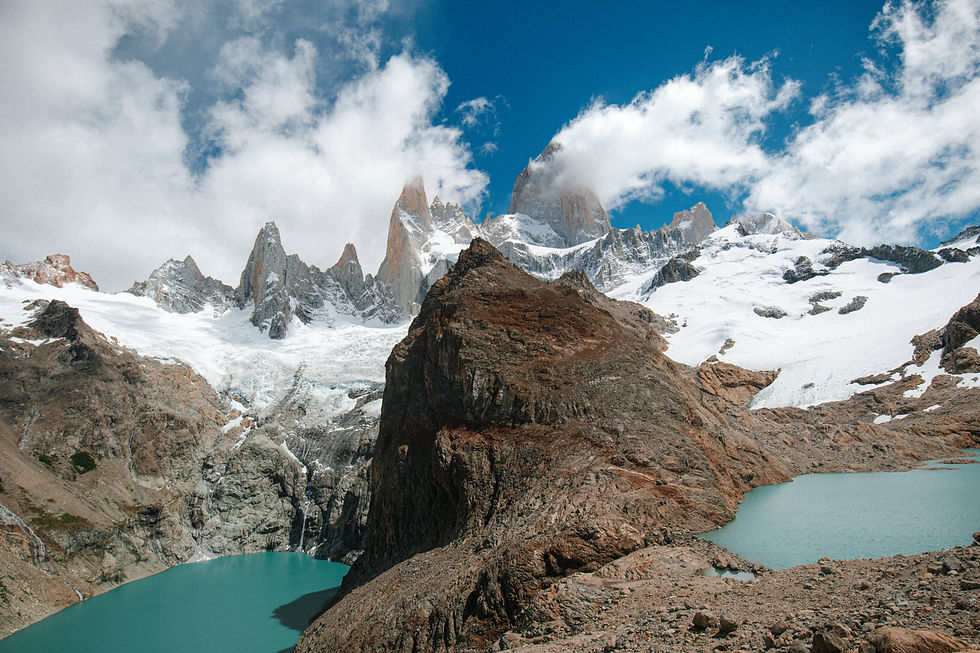
This is the most famous hike in El Chaltén and probably the main reason why so many people come here. The view of the Fitz Roy peaks rising above the bright blue glacial lake is iconic. We started hiking around 8 a.m. We began our route via a small path near a hostel. We didn’t come across a ticket office along the way.
Today’s route was 24 kilometers long, with about 1,200 meters of elevation gain and loss. Most hikers start and finish in El Chaltén. Another option is to take a shuttle bus to Rio Electrico, seventeen kilometers away. From there, you walk past the Piedra Blanca glacier and join the main trail toward El Chaltén. We opted for our own custom “Option Three”: we started in El Chaltén, so we had a continuous view of the Fitz Roy peaks on the way there. After visiting the lake, we walked via the glacier to Rio Electrico, planning to hitchhike back to the village from there.
Everything went perfectly. The air was clear, and the views were stunning all day long. Our favorite part was a waterfall just off the trail. To our surprise, we were completely alone there, while the main path was incredibly crowded. It’s no wonder the place is called the “Secret Waterfall.” It was precisely that tranquility that made it so special. Still, we wanted to share this good fortune with others, so along the way we tipped off a few people, who immediately went to take a look, full of enthusiasm.
The route to the lake began with a climb through the forest, followed by a long, flat stretch across open terrain. The last kilometer was the section everyone had warned us about. We’d read beforehand just how tough it would be. And yes, it was grueling, but not terrible. The blazing sun with no shade and the steep 600-meter climb over a single kilometer made it challenging.
At the summit, we were greeted by a cold glacial wind. And there they were: Cerro Chaltén (Fitz Roy) and the surrounding peaks. Almost completely clear—what a stroke of luck. The glacial lake shimmered bright blue in the sunlight. While taking photos, we saw a fox emerge from among the rocks. It walked nonchalantly past the people, while everyone had their eyes fixed on the lake. A moment later, a falcon appeared as well, just as bold. A beautiful pair.
For most people, Laguna de los Tres is the final destination, but if you climb a little further up, you’ll find yourself looking out over yet another lake. What a view. Today we were especially lucky—there was hardly any wind, so we could sit here in peace. Often the wind blows so hard that people quickly head back down. After enjoying the view for a while, we too began our descent.
At the open plain, the route split. One path led back to El Chaltén, the other to Rio Electrico, both about eight kilometers long. We chose Rio Electrico. That section was remarkably quiet and ran mostly through the forest, with a gradual descent. The highlight was the view of the glacier; otherwise, it was a pleasant, though somewhat less spectacular, hike.
In Rio Electrico, we tried to hitchhike. After a few cars passed by, a large bus stopped. Two Argentinians from Buenos Aires offered us a ride. There was really only one seat left, which we had to share, but we were happy. Walking back would have taken another five hours, and after such a long day, we didn’t have the energy for that. We were back in the village around dinnertime.
Loma del Pliegue Tumbado
Distance: approximately 19 kilometers round trip
Elevation gain: approximately 1,000 meters
Difficulty: moderate
Our final day hike from El Chaltén is called Loma del Pliegue Tumbado: a 19-kilometer round trip with about 1,000 meters of elevation gain. We did this hike the day after our hike to Laguna de los Tres, and it was quite challenging. We set off at 7:30 a.m. from the official starting point.
The layout of this hike is similar to that of Laguna de los Tres: first a steady climb through forested terrain, then a longer, flatter stretch, and finally another steep ascent toward the summit. What makes this hike special is that from the summit, you get a completely different perspective than on the other day hikes. Whereas at Laguna de los Tres you mainly look toward Fitz Roy, here you look out over Laguna Torre and Cerro Torre. The landscape unfolds broadly before you, with glaciers, valleys, and jagged mountain peaks. Because you’re a bit further away from the peaks, the view feels vast and panoramic.
From the official endpoint, you can climb another 300 meters or so to reach an even higher viewpoint. We decided to skip this extra climb (our legs had definitely reached their limit), but if you still have some energy left, the view from there is apparently impressive as well.
After lunch at the summit, we began the descent. It went surprisingly smoothly. Maybe because the trail isn’t technically difficult, or maybe because we knew this was our last hike here.
By around three o'clock, we were back down in El Chaltén.
Loma del Pliegue Tumbado is less crowded than Laguna de los Tres, but the views are just as spectacular. It was the perfect way to wrap up our hiking days in Patagonia.
In conclusion:
As far as we’re concerned, El Chaltén is the kind of place where you end up staying longer than planned. The combination of rugged mountain landscapes and accessible day hikes makes it addictive. Yes, prices are higher than in the rest of Argentina, and yes, some hikes are challenging. But the views of Cerro Chaltén (Fitz Roy), Cerro Torre, and the bright blue glacial lakes more than make up for it. Would you do just one hike here… or, like us, keep staying “just one more day”?


Comments