


Santa Cruz Trek: a four-day hike through the Cordillera Blanca

Updated: Feb 15
The Santa Cruz Trek is one of the most famous multi-day hikes in Peru. The trek takes you right through the Cordillera Blanca, an impressive mountain range with snow-capped peaks, turquoise glacial lakes, and vast valleys. In four days, you will hike from small farming villages to rugged mountain passes above 4,700 meters. A challenging but unforgettable experience.

How much does the Santa Cruz Trek cost?
During the low season (October to April), the Santa Cruz Trek costs between 700 and 750 soles per person (€180-€190 per person)* on average. This price includes a guide, cook, donkeys for luggage, meals, and camping equipment.
The price is often negotiable. For example, if you book the trek together with other tours, such as Laguna 69, or if you go with a group, you can usually arrange a more affordable package.
*Price in the year 2025.
What to bring during the low season?
The low season in Huaraz (October to April) is characterized by changeable weather: sunny mornings, rainy afternoons, and cold nights. Good preparation is essential.
Recommended packing list for the Santa Cruz Trek:
Sun hat
Hat and gloves
Thermal clothing
Rainwear
Sturdy hiking boots
Hiking poles
Slippers for the camp
Waterproof bag for luggage (travels with the donkeys)
Daypack for items you need along the way
Water for the first day (this will be provided on the other days)
Hydration pack or water bottle
Dried fruit or nuts as snacks
Sunscreen
Insect repellent (DEET)
Card game or other pastime
First aid kit
Medication for altitude sickness, such as Diamox
Day-by-day report of the Santa Cruz Trek
Day 1 – From Vaquería to Paria
Distance: 11 kilometers
Ascent: 434 meters
Highest point: 3,817 meters
Early in the morning, at five o'clock, we were picked up at our hotel in Huaraz. To our surprise, we found ourselves in a group of fifteen people instead of the agreed five, with only one guide. After about two hours of driving, we stopped for breakfast at a restaurant along the route. This breakfast was not included and cost us 20 soles (about €5 per person). We continued the bumpy bus ride over the Portachuelo de Llanganuco pass (4,765 meters) and after about 3 hours we reached the starting point in Vaquería.

Our luggage was loaded onto donkeys and we were given a snack pack for the first day. The route began through small farming villages with cows and donkeys, after which the path slowly climbed through the Paria Valley. The surroundings became greener and wilder, with the scent of eucalyptus, small rivers, and waterfalls.
At the end of the afternoon, we arrived at our campsite by a river. The cook and his assistant had already pitched the tents. The atmosphere was good, even though we were plagued by sand flies. Covering clothing and insect repellent were essential.
In the evening, it turned out that the group was actually too large: the restaurant was too small, so we ended up sitting with our plates on our laps. After dinner, everyone went to bed early to rest up for the next day.
Day 2 – Climb to Punta Unión
Distance: 10.3 kilometers
Ascent: 837 meters
Highest point: 4,750 meters
After a hearty breakfast, we set out on the toughest day of the trek. The climb to Punta Unión is long and steep, and the thin air makes every step harder. Just before the summit, we had to stop regularly to catch our breath. We kept a steady pace, which ultimately worked well.
At the top of the pass, we were rewarded with breathtaking views of the valleys and lake below us. Not long after, clouds rolled in and it started to rain. The descent to the next camp took place in thick fog, and when we arrived, our luggage was unfortunately completely soaked.
Our clothes and sleeping gear were wet, and drying them was impossible. We would have to walk and sleep in the same clothes for the next two days. Our tip: put the things you take with the donkey in a waterproof bag!
In the evening, we played card games in the restaurant and crawled into our sleeping bags early.

Day 3 – Via Arhuaycocha to Llamacorral
Distance: 21.2 kilometers
Ascent: 406 meters
Highest point: 4,426 meters
The third day started cold but dry. After breakfast, we set off for the glacial lake Arhuaycocha, a small detour that was definitely worth it. Along the way, we passed through valleys where we saw the skeletons of horses and donkeys: the remains of pumas' prey.
At the lake, at an altitude of 4,420 meters, we had a view of the imposing Alpamayo (5,947 meters). After a short break, we began the long descent to the camp at Llamacorral. The route took us through forests, valleys, and past rivers and waterfalls.
At the end of the afternoon, we reached the camp just before it started raining again. The surroundings were spectacular: a valley with waterfalls and a flowing river. This was without a doubt the most beautiful camping spot of the trek for us.
Day 4 – Descent to Cashapampa
Distance: approximately 10 kilometers
Ascent: negligible, mostly descent
On our final morning, we awoke to clear blue skies. For the first time, we were able to enjoy breakfast outside, with a view of the surrounding mountains. The descent to Cashapampa was relaxed and mostly followed a river, through eucalyptus forests and open valleys.
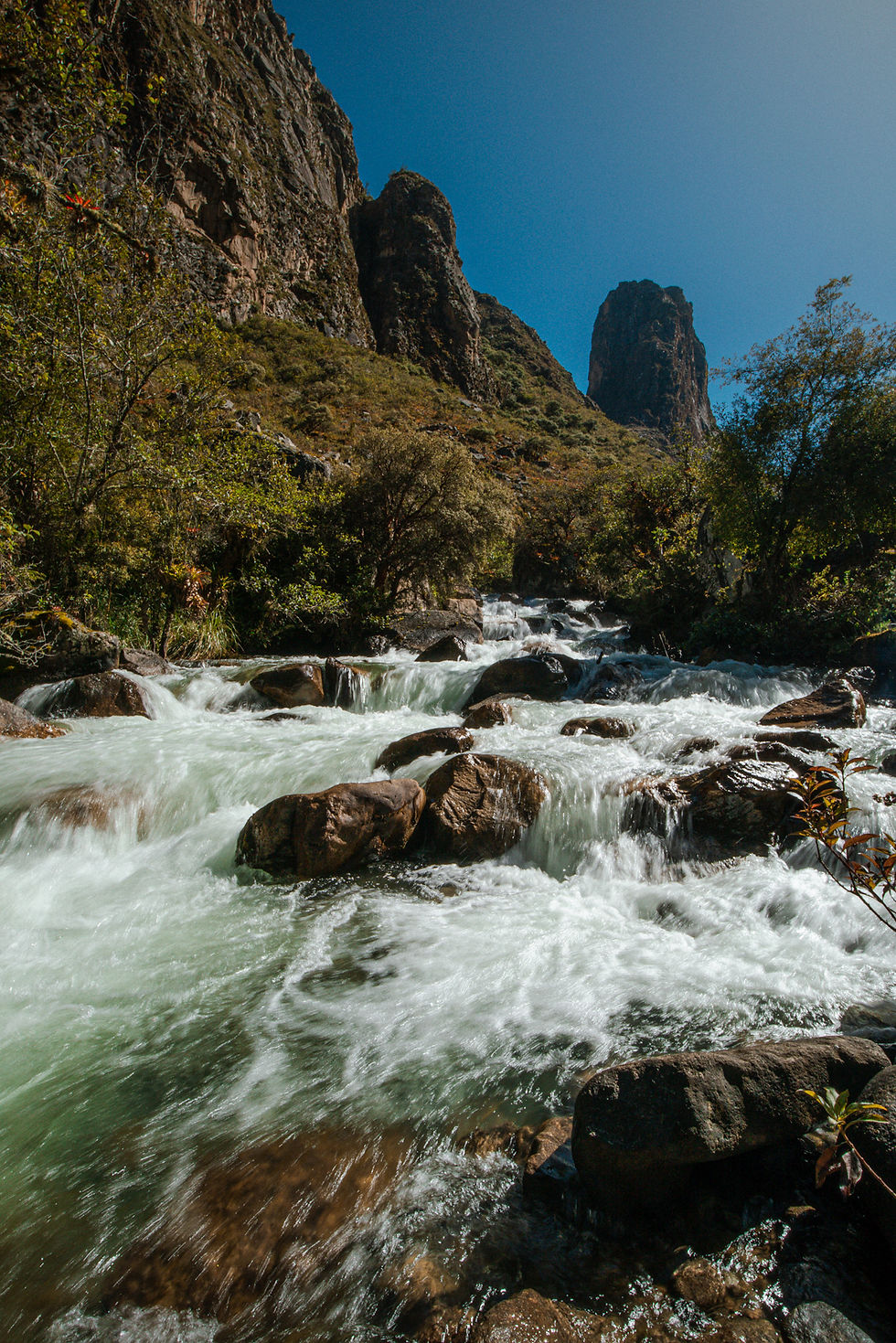
Around ten o'clock in the morning, we reached the end of the trek. After four days of walking, cold, and rain, it was a great feeling to be back in civilization. After about a three-hour drive, we were back in Huaraz and enjoyed our first hot shower, a hearty meal, and a real bed. Almost as nice as completing the trek itself.
In conclusion
The Santa Cruz Trek is a physical challenge, but above all a wonderful adventure. You walk through impressive mountain landscapes, learn to cope with the altitude, and experience how simple life can be in nature. Rain, cold, and fatigue are part of the experience, but they only add to the sense of satisfaction.
For those who love adventure, nature, and tranquility, the Santa Cruz Trek is highly recommended.


Comments