


Motorcycle tour through the Sacred Valley, Cusco

Updated: Feb 15
Many people have asked us: will you be riding motorcycles during your trip? Originally, this wasn't part of our plan, because we thought that the roads and traffic in Peru weren't very good. We were pleasantly surprised when we explored the area around Cusco. Most of the roads here were well paved or accessible off-road trails. So during our visit to the Sacred Valley, a new adventure awaited us: a motorcycle tour.
Where can you rent a motorcycle in Cusco?
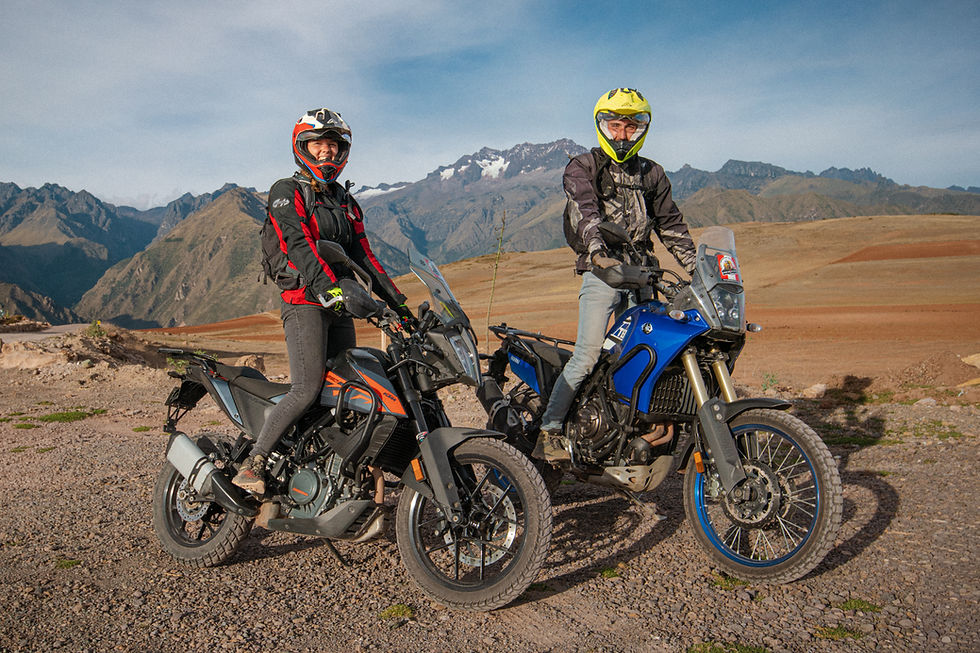
We chose to ride with Peru Moto Tours and booked a guide to navigate us through the valley. This was ideal, as it allowed us to ride in a relaxed manner and focus entirely on the surroundings.
Oscar rode a Yamaha Ténéré 700 and I rode a KTM 390 Adventure. Both were completely different from our own motorcycles, but perfect for the off-road sections we encountered during our tour.
Our route as GPX
For those who want to discover the Sacred Valley by motorbike, we have included our complete route below. It takes you past the most impressive places in the valley: from Cusco to Pisac, via winding mountain roads towards Ollantaytambo and on to the salt terraces of Maras. The route combines both paved and accessible off-road sections, allowing you to ride on wide, smooth roads and rougher gravel paths.
The significance of the Sacred Valley for the Incas
The Sacred Valley was one of the most important areas of the Inca Empire. The Urubamba River flows through the center of the valley, and thanks to its mild climate, it was the ideal place for agriculture. Not only was it the breadbasket of the Andes, but it was also a spiritual center full of ceremonial sites and impressive terraces.
The valley also formed the strategic connection between Cusco, the heart of the empire, and the lower jungle areas. As a result, the region played a major role in trade, food supply, and the political administration of the Incas.
Pisac: terraces, stars, and a city of the dead in the mountainside
Our first stop was Pisac, known for its enormous network of agricultural terraces against the mountainsides. The terraces were built with great precision to make clever use of differences in altitude and microclimates. An ingenious example of Inca engineering.
Above the terraces lies the ceremonial center, with remains of temples, altars, and astronomical observation points where the Incas performed rituals and studied the position of the sun and stars. Also not to be missed is the city of the dead, with burial caves carved into vertical rock faces.
Ollantaytambo: the fortress where the Incas held their ground
We then drove on to Ollantaytambo: a place that feels like both an archaeological complex and a living town. It was once a fortress and ceremonial settlement and is the only place where the Incas managed to repel a Spanish invasion.
The terraces here run monumentally in straight lines up towards Temple Hill, where you can see the remains of the Temple of the Sun. At the bottom lies the village of Ollantaytambo, with an original Inca city layout: narrow alleys, flowing water channels, and trapezoidal doorways. You literally walk through history here.
Maras salt terraces: centuries old and still in use
At the end of the day, we visited the salt terraces of Maras. The landscape is almost surreal: hundreds of small, staircase-shaped basins against the mountainside, each filled with salty water from a spring higher up the mountain. When the water slowly evaporates, crystalline salt remains.
The system has been in use since pre-Inca times and still works in exactly the same way. The Incas managed the terraces collectively and divided them among families. Salt played an important role in trade, preservation, and spirituality. The spring was considered sacred and linked to Pachamama, the mother goddess of the earth. Today, local families still harvest the salt by hand.
Finally: back to Cusco
After Maras, we began the journey back to Cusco, via beautiful winding roads and views that you can never get enough of.
Exploring the Sacred Valley on a motorcycle is a wonderful combination of history, nature, and adventure. Highly recommended for anyone who wants to combine a love of motorcycles with a curiosity about culture.


Comments